
Interior Ideas
what are mushroom spores
Jun
What Are Mushroom Spores? A Complete Guide to Nature’s Microscopic Reproductive Cells
Mushrooms have fascinated people for centuries. They appear almost overnight after rain, come in an incredible variety of colors and shapes, and play an essential role in maintaining healthy ecosystems. While the visible mushroom is what most people recognize, it represents only a small part of a much larger fungal organism. One of the most remarkable aspects of mushrooms is how they reproduce—through tiny, microscopic structures known as spores.
Mushroom spores are often compared to plant seeds because both serve as reproductive units. However, spores and seeds are fundamentally different in their structure, function, and biology. Understanding mushroom spores provides valuable insight into the fascinating world of fungi, their life cycles, ecological importance, and scientific study.
In this comprehensive guide, we’ll explore what mushroom spores are, how they are produced, how they differ from seeds, how they spread throughout nature, their role in ecosystems, and why they are so important to researchers, educators, and mushroom enthusiasts.
What Are Mushroom Spores?
A mushroom spore is a microscopic reproductive cell produced by fungi. Its primary purpose is to allow fungi to reproduce and spread to new environments where they may establish new fungal colonies if conditions are favorable.
Unlike seeds, spores contain very little stored nutrition. Instead, they are lightweight reproductive structures designed for dispersal. Their tiny size allows them to travel long distances by wind, water, insects, animals, or other natural means what are mushroom spores.
Most mushroom spores are invisible to the naked eye. Millions—even billions—of spores may be released by a single mature mushroom during its reproductive phase what are mushroom spores.
The Mushroom Is Only Part of the Fungus
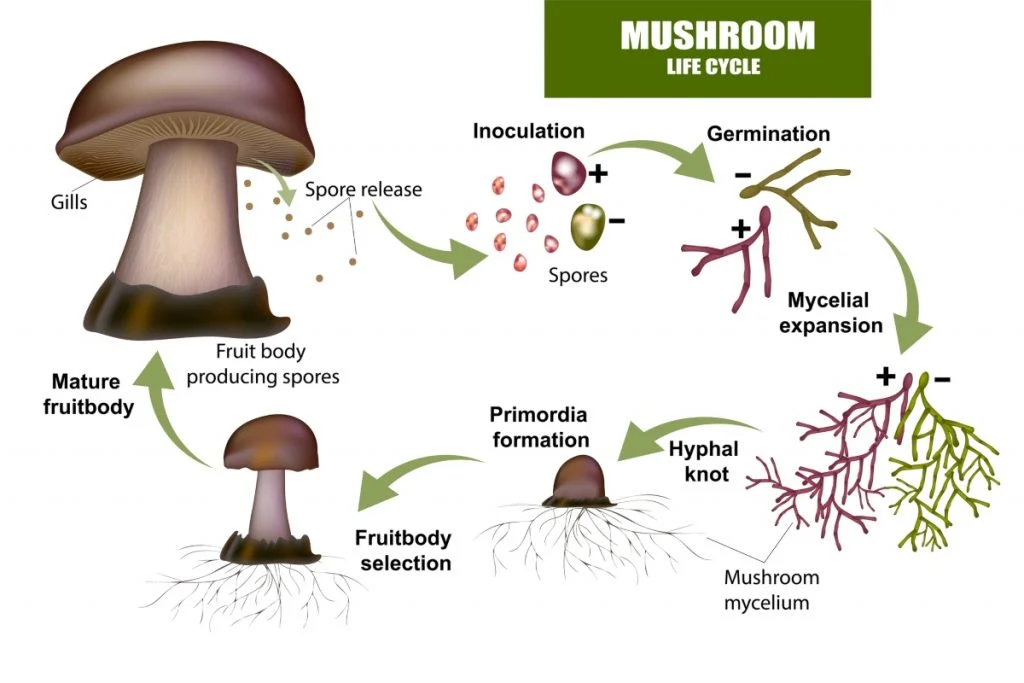
Many people think the mushroom itself is the entire organism. In reality, the mushroom is simply the fruiting body of a fungus.
Most of the fungus exists beneath the ground or within wood, leaf litter, or other organic material as a network of thread-like structures called mycelium. This hidden network absorbs nutrients, breaks down organic matter, and supports the growth of the visible mushroom.
When environmental conditions become favorable—often after adequate moisture and suitable temperatures—the fungus produces mushrooms. These mushrooms exist primarily to create and release spores, allowing the species to reproduce and disperse.
How Mushroom Spores Are Produced
Spores are produced by specialized reproductive cells located on or within the mushroom’s spore-bearing surface. Depending on the type of mushroom, this surface may be found on what are mushroom spores:
- Gills
- Pores
- Teeth or spines
- Smooth surfaces
- Other specialized structures
As the mushroom matures, enormous numbers of spores develop on these reproductive surfaces.
Once mature, the spores are released into the surrounding environment through natural processes. Air currents often carry them away from the parent mushroom, increasing the chances that some will eventually reach suitable habitats.
How Small Are Mushroom Spores?
Mushroom spores are incredibly tiny.
Most spores measure only a few micrometers in length. For comparison:
- A human hair is approximately 50 to 100 micrometers wide.
- Many mushroom spores are only 5 to 15 micrometers long.
Because of their microscopic size, spores require magnification to observe their detailed shape, ornamentation, and color.
Under a microscope, spores can display remarkable diversity. Some are smooth, while others have ridges, spines, or textured surfaces that help scientists identify different species.
What Do Mushroom Spores Look Like?
Although invisible individually, spores possess distinctive characteristics that become apparent under magnification.
They may vary in:
- Shape
- Size
- Surface texture
- Wall thickness
- Color
- Internal structures
Common spore shapes include:
- Oval
- Elliptical
- Spherical
- Cylindrical
- Kidney-shaped
- Almond-shaped
These microscopic features are valuable tools in fungal identification and taxonomy.
Mushroom Spores vs. Seeds
People often compare spores to seeds because both enable reproduction, but they differ in several important ways.
Size
Seeds are generally much larger than spores and can often be seen without magnification.
Spores are microscopic and usually invisible individually.
Nutrition
Seeds contain stored food that nourishes a developing plant embryo.
Spores contain minimal nutrient reserves and depend on favorable environmental conditions to develop.
Structure
Seeds contain an embryo.
Spores consist of a single reproductive cell capable of beginning the fungal life cycle under suitable conditions.
Production
Plants usually produce hundreds or thousands of seeds.
Many mushrooms produce millions or even billions of spores during their lifetime.
How Do Mushroom Spores Spread?
Successful reproduction depends on spores reaching suitable habitats.
Nature has evolved several efficient methods for dispersal.
Wind
Wind is one of the most effective methods of spore distribution.
Because spores are extremely lightweight, even gentle air currents can transport them considerable distances.
Water
Rainwater and flowing streams can carry spores through forests, fields, and other habitats.
Animals
Animals may accidentally transport spores on:
- Fur
- Feathers
- Feet
- Skin
Some spores also pass through digestive systems after animals consume mushrooms.
Insects
Various insects visiting mushrooms may carry spores from one location to another.
Human Activity
People can unintentionally transport spores on:
- Clothing
- Boots
- Equipment
- Vehicles
Human movement contributes to fungal dispersal in both natural and managed environments.
What Happens After a Spore Lands?
Landing in a new location is only the beginning.
A spore must encounter suitable environmental conditions before it can continue the fungal life cycle.
Important factors include:
- Adequate moisture
- Appropriate temperature
- Suitable substrate
- Available nutrients
- Favorable environmental conditions
When these requirements are met, a spore may germinate and produce tiny fungal threads called hyphae.
These hyphae grow and branch repeatedly, eventually forming an interconnected network known as mycelium.
Given enough resources and the right environmental cues, the mycelium may later produce mushrooms, completing the reproductive cycle.
Why Are Mushroom Spores Important?
Spores are essential to fungal survival and biodiversity.
Without spores, fungi would have limited ability to reproduce or colonize new habitats.
They allow fungal species to:
- Expand into new areas
- Maintain genetic diversity
- Survive changing environmental conditions
- Colonize newly available organic material
- Continue ecological nutrient cycling
Their extraordinary abundance increases the likelihood that at least a small number will encounter conditions suitable for growth.
The Role of Mushroom Spores in Nature
Fungi perform countless ecological functions, and spores are central to their continued presence in ecosystems.
Decomposition
Many fungi break down dead wood, leaves, and other organic material.
This process recycles nutrients back into ecosystems, supporting plant growth and soil health.
Soil Formation
By decomposing organic matter, fungi contribute to the gradual formation of healthy soils.
Plant Partnerships
Many fungi form mutually beneficial relationships with plant roots, helping plants absorb water and nutrients while receiving sugars in return.
Wildlife Support
Fungi provide food and habitat for numerous organisms, from insects to mammals.
Spore production helps sustain fungal populations that support these ecological interactions.
Why Scientists Study Mushroom Spores
Spores contain valuable information about fungal biology and diversity.
Researchers study them for purposes including:
- Species identification
- Taxonomy
- Evolutionary relationships
- Biodiversity surveys
- Ecology
- Conservation
- Environmental monitoring
Microscopic examination of spores often helps distinguish between species that appear very similar to the naked eye.
Spore Prints: A Valuable Identification Tool
One of the most familiar ways to observe spores collectively is by creating a spore print.
A mature mushroom cap is placed with its spore-bearing surface facing downward onto paper, glass, or another suitable surface.
After several hours, released spores accumulate into a visible pattern.
Spore print colors vary widely and may include:
- White
- Cream
- Pink
- Brown
- Purple-brown
- Black
- Rust-colored
Spore print color is one characteristic used alongside many others in mushroom identification.
Are Mushroom Spores Everywhere?
Yes. Mushroom spores are present in nearly every environment on Earth.
They can be found in:
- Forests
- Grasslands
- Deserts
- Urban parks
- Agricultural fields
- Indoor environments
- Mountain ecosystems
Air sampling studies have shown that fungal spores are a natural component of the atmosphere and are continuously circulating around the globe.
How Long Can Mushroom Spores Survive?
The longevity of spores depends on multiple factors, including:
- Species
- Temperature
- Moisture
- Exposure to sunlight
- Storage conditions
- Environmental stress
Some spores remain viable for extended periods under favorable conditions, while others lose viability more quickly. Cooler, darker, and drier environments generally help preserve stored spore samples used for microscopy, education, or scientific reference.
Factors That Affect Spore Survival
Several environmental conditions influence how well spores persist over time.
Moisture
Excessive moisture may encourage contamination or premature deterioration.
Temperature
Stable, cool temperatures generally slow biological aging.
Light
Prolonged ultraviolet exposure can damage biological materials.
Physical Damage
Improper handling or storage may reduce sample quality.
Contamination
Exposure to dust, mold, or bacteria may affect preserved specimens intended for study.
Common Misconceptions About Mushroom Spores
“Spores Are Seeds”
Although spores and seeds both function in reproduction, they are biologically distinct structures with different developmental strategies.
“Every Spore Produces a Mushroom”
Only a tiny fraction of spores encounter the precise environmental conditions needed to establish a new fungal colony.
“Spores Are Visible Individually”
Individual spores are microscopic and require magnification for detailed observation.
“All Mushroom Spores Look the Same”
Different fungal species produce spores with a remarkable diversity of sizes, shapes, textures, and colors.
The Incredible Numbers Behind Mushroom Spores
One of the most astonishing facts about fungi is the sheer quantity of spores they produce.
A single mature mushroom may release millions or even billions of spores over its reproductive period. This enormous output compensates for the fact that only a very small percentage of spores will eventually land in locations where they can successfully contribute to the fungal life cycle.
This reproductive strategy has helped fungi thrive for hundreds of millions of years across nearly every terrestrial ecosystem.
Why Mushroom Spores Matter Beyond the Forest
While spores are often associated with woodland mushrooms, their importance extends far beyond forests.
Fungi contribute to:
- Nutrient recycling
- Soil fertility
- Plant health
- Ecosystem stability
- Scientific research
- Education
- Biodiversity conservation
Spores make these contributions possible by ensuring fungi continue to spread, adapt, and occupy suitable habitats around the world.
As researchers learn more about fungal diversity, mushroom spores also provide valuable clues about environmental change, species distribution, and the health of natural ecosystems.
Frequently Asked Questions
Are mushroom spores alive?
Spores are living reproductive cells that can remain dormant until they encounter environmental conditions that support further development.
Can you see mushroom spores without a microscope?
Individual spores are generally too small to see with the naked eye. However, when many spores collect together, such as in a spore print, they form a visible deposit.
Why do mushrooms produce so many spores?
Only a small fraction of released spores reach suitable environments. Producing vast numbers increases the chances of successful reproduction.
Are all mushroom spores the same color?
No. Individual spores and spore prints vary in color depending on the species. Spore print color is one characteristic used in fungal identification.
Why are spores important to scientists?
Spore size, shape, color, and surface features provide valuable information for identifying fungi, studying biodiversity, and understanding evolutionary relationships.
Conclusion
Mushroom spores are among nature’s most remarkable reproductive structures. Though microscopic in size, they play an enormous role in the survival and spread of fungi across the globe. Produced in extraordinary numbers, spores allow fungi to colonize new environments, recycle nutrients, support healthy ecosystems, and contribute to the incredible diversity of life on Earth.
Understanding what mushroom spores are reveals that the familiar mushroom is only one stage in a much larger fungal life cycle. Hidden beneath the soil or within decaying wood, extensive networks of mycelium rely on spores to continue their species from one generation to the next. Their ability to travel by wind, water, insects, animals, and other natural forces has enabled fungi to inhabit nearly every terrestrial ecosystem.
For scientists, educators, naturalists, and curious readers alike, mushroom spores offer a fascinating window into the biology of fungi. Their microscopic forms help identify species, their dispersal shapes ecosystems, and their resilience highlights the remarkable adaptations of the fungal kingdom. Although tiny and often overlooked, mushroom spores are fundamental to the health of forests, grasslands, gardens, and countless other environments where fungi quietly perform their essential work.
